
A burst pipe at midnight. A gas smell drifting through the strata car park at dawn. A flooded retail tenancy discovered on a Sunday morning. If you manage a commercial property or strata complex in Perth, you know that plumbing and gas emergencies do not wait for business hours.
Calling an emergency plumber Perth is always the right first move, but knowing what to do before help arrives can make a real difference. Shutting off the right valve, evacuating the right area, and having the right information ready can limit water damage, prevent gas hazards, and keep your tenants and staff safe.
Alkimos Plumbing and Gas has attended countless after-hours callouts across Perth’s commercial, retail, and strata properties. In this guide, we walk you through a practical after-hours triage checklist, covering exactly what to shut off, what to contain, and what to report so your next emergency is handled with confidence.
Why Perth Businesses and Strata Properties Face Unique Plumbing Risks
Perth’s climate and infrastructure create plumbing challenges specific to this city. Understanding them helps property managers and strata committees prepare for what is most likely to go wrong.
Water Corporation WA recommends keeping mains water pressure below 500 kPa, yet many older commercial buildings still lack adequate pressure-limiting valves. High pressure accelerates wear on fittings, valves, and hot water systems, making sudden failures more likely, particularly during summer when demand spikes.
Coastal and sandy soils, common across Perth’s northern and southern suburbs, can shift beneath building slabs over time. This gradual movement stresses underground pipe joints and leads to cracks that go undetected until they surface as a flooding emergency or an unexplained spike in your water bill.
Strata complexes add another layer of complexity. Shared water metres, common area reticulation, and a chain of responsibility between lot owners, the body corporate, and strata managers mean a quick, coordinated response depends on knowing your role before something goes wrong.
Common after-hours plumbing emergencies our team attends at Perth commercial and strata properties include:
- Burst mains or supply lines caused by pressure spikes or ageing fitting
- Hot water system failures in multi-residential buildings
- Blocked or overwhelmed sewers causing backflow into tenancies
- Gas leaks in commercial kitchens, plant rooms, or storage areas
- Storm-related drainage overflow affecting common areas and lobbies
Calling an Emergency Plumber Perth: Your After-Hours Triage Checklist
When a plumbing or gas emergency strikes, it is easy to panic. A clear sequence of actions takes the guesswork out of the situation and protects people and property. Print this checklist and post it in your plant room or strata office.
Step 1: Assess before you act
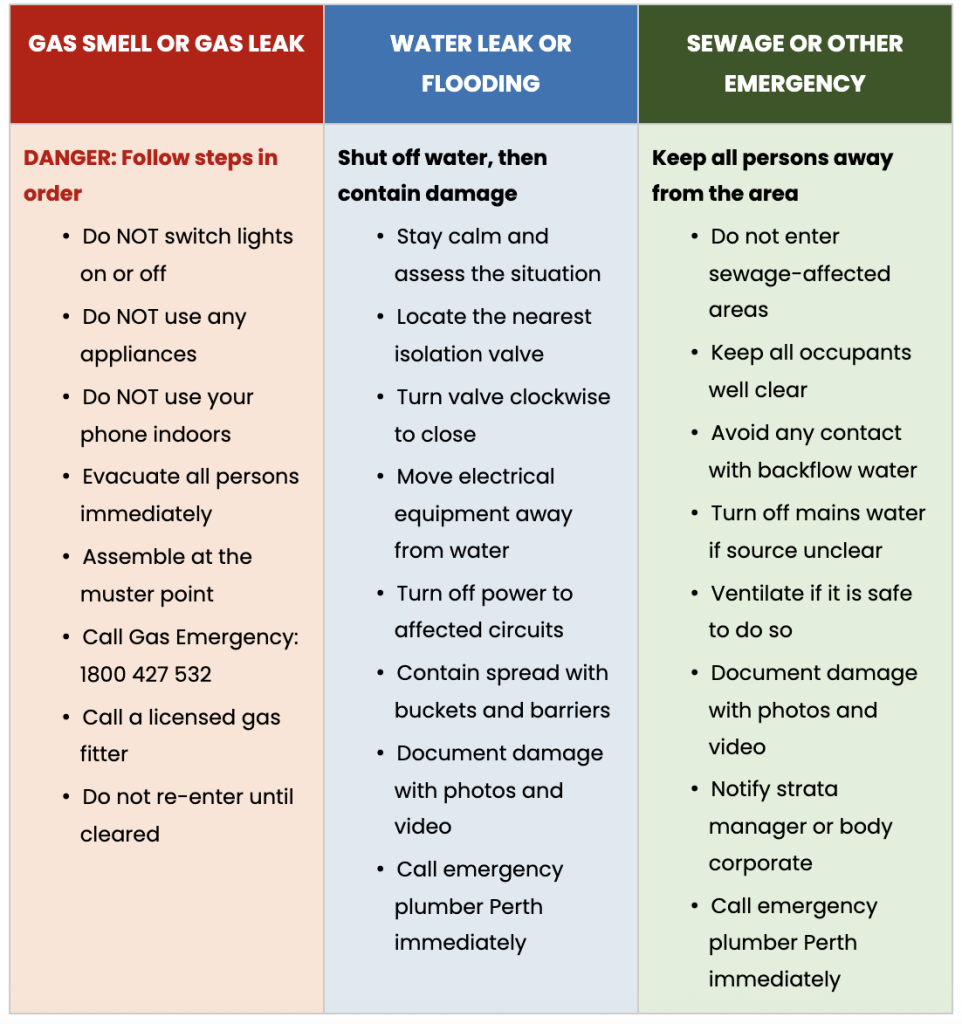
Take 15 seconds to assess what you are dealing with. Is there water actively flowing? Can you smell gas? Is any electrical equipment in contact with water? Your safety and the safety of others on the property comes first.
Step 2: Gas smell? Evacuate immediately
If you can smell gas, do not switch lights on or off, do not use any appliances, and do not use your phone inside the building. Evacuate everyone from the affected area straight away. Once outside, call the 24-hour Gas Emergency Line on 1800 427 532. Energy Safety WA provides detailed guidance on responding to gas emergencies at commercial premises.
Step 3: Water leak? Locate and close the nearest isolation valve
For active water leaks, find and close the nearest isolation valve. In most commercial properties, this is the main water metre at the property boundary, a zone valve in the plant room, or an individual shutoff valve under a sink or behind a toilet cistern. Turn the valve clockwise to close.
Step 4: Contain and document the damage
Once the source is isolated, or while waiting for your plumber if it cannot be safely isolated, take the following steps:
- Place buckets, towels, or absorbent barriers to limit water spread
- Move electrical equipment, stock, and documents away from wet areas
- Turn off power to any circuit near the affected area at the switchboard
- Photograph and video the damage before beginning any clean-up (your insurer will need this)
Step 5: Call your plumber and notify all relevant parties
Call for professional help and then notify tenants, the strata manager, or the body corporate as appropriate. If gas has been isolated, inform all occupants that no appliances can be used until a licensed gas fitter has inspected and cleared the property. For guidance on finding the right licensed professional, see our blog on how to find the right gas plumber.
Quick Reference: Emergency Triage Decision Guide
How to Safely Shut Off Water and Gas Before Your Plumber Arrives
Knowing where your shutoffs are before an emergency is one of the most valuable things you can do as a property manager or strata committee member. Ideally, a hydraulic services diagram is posted in the plant room or held on file by your facilities manager.
Water shutoffs
The main water metre is your primary shutoff. It is typically located:
- At the front boundary of the property in a below-ground metre box
- In a basement plant room or dedicated services room on larger buildings
- Near the street kerb on smaller commercial properties
Turn the valve clockwise to close. If it is stiff or corroded, do not force it. Forcing a damaged valve can cause it to fail completely. Call a plumber who can close the supply from the street if needed.
Zone isolation valves allow you to shut off water to a specific area without cutting supply to the entire building. This is invaluable for multi-tenancy properties. If your building does not have zone valves, it is worth discussing their installation with your commercial plumbing service provider during your next scheduled maintenance.
Gas shutoffs
Every commercial property connected to reticulated gas should have a clearly labelled isolation valve at the gas metre, mounted on an external wall. This is a quarter-turn ball valve. When the handle runs parallel to the pipe, gas is flowing. Turn the handle perpendicular (90 degrees) to the pipe to close it.
Under the Gas Standards Act 1972 (WA), only a licensed gas fitter can reinstate a gas supply after an emergency shutoff. Do not attempt to turn the gas back on yourself. Energy Safety WA publishes clear requirements around gas safety compliance for commercial properties in Western Australia.
If you cannot safely reach the metre valve, or if you are unsure whether the issue is gas-related, evacuate the building and call the Gas Emergency Line immediately. For ongoing safety and compliance, Alkimos Plumbing and Gas provides gas fitting and repair services across Perth to keep your property safe and up to code.
What to Tell Your Emergency Plumber Perth When You Call
The faster your plumber understands the situation, the faster they can bring the right equipment and get the job done. When you call, have the following information ready.
Your location and access details
- Full property address, including tenancy or unit number
- Access codes, gate PINs, or key safe combinations
- Location of the affected area within the building (for example, Level 2 bathroom, plant room, or common area car park)
- Whether there is safe access for a service vehicle
The nature of the emergency
- Is water actively flowing, or has it been isolated?
- Is there a gas smell or a confirmed leak?
- Is the issue in a ceiling, wall, underground, or at a visible fixture?
- Are any electrical systems in contact with water?
What you have already done
- Have you isolated water or gas supply?
- Have you turned off power to any affected circuits?
- Has anyone been injured, or is anyone still at risk?
Property and system details
- Property type: residential strata, commercial tenancy, or industrial
- Age of the building and pipe material if known (copper, CPVC, PEX, or cast iron)
- Whether the property uses town gas, LPG, or has no gas supply at all
- Whether a hot water system is involved
Having this information ready reduces response time and can lower your callout costs. When you contact Alkimos Plumbing and Gas for an after-hours emergency, our team will guide you through the immediate safety steps while dispatching a technician to your property.
Strata Properties: Responsibilities and Who Calls Whom
Strata properties present a unique challenge in plumbing emergencies because responsibility is shared, and the wrong response can create disputes between lot owners and the body corporate.
Under Western Australian strata legislation, the body corporate is responsible for common property plumbing. This includes shared water supply pipes, drainage in common areas, and any infrastructure that serves more than one lot. Individual lot owners are responsible for plumbing within their own lot boundary.
Strata Emergency: Who Is Responsible?
|
Emergency Type |
Responsible Party |
|
Burst main in car park or common area |
Body Corporate |
|
Blocked or leaking toilet inside a lot |
Lot Owner |
|
Failed shared hot water system on rooftop |
Body Corporate |
|
Leaking tap or pipe inside an apartment |
Lot Owner |
|
Overflowing drain in lobby or common area |
Body Corporate |
|
Gas leak from a lot’s own appliance |
Lot Owner |
|
Underground pipe beneath a common driveway |
Body Corporate |
Practical steps for strata managers when an emergency call comes in:
- Confirm whether the affected area is common property or within a lot
- If common property, authorise an emergency callout immediately. Most strata management agreements allow emergency expenditure up to a set threshold without full body corporate approval
- If the problem is within a lot, contact the lot owner and advise them to arrange their own plumber
- Notify all affected residents if water supply is being shut off
- Document everything in writing, including the time of the call, the response taken, and the outcome
For strata complexes with recurring plumbing issues, a preventative maintenance plan is far more cost-effective than repeat emergency callouts. Alkimos Plumbing and Gas provides commercial plumbing services across Perth, including scheduled maintenance contracts for strata and commercial properties.
If your property has unexplained increases in water usage or a suspected underground leak, our acoustic leak detection service for commercial sites can locate hidden leaks accurately without unnecessary excavation.
When to Handle It Yourself and When to Call a Professional
There are a handful of actions you or your facilities team can safely take in a plumbing emergency. There are also actions that can make the situation significantly worse, or create a legal liability.
What you can safely do yourself
- Turn off water at the main metre or an isolation valve
- Turn off gas at the metre using the quarter-turn ball valve
- Mop up surface water and contain the affected area with barriers
- Turn off power to an affected circuit at the switchboard
- Photograph and video the damage for insurance purpose
- Contact tenants, the body corporate, and your insurer to report the incident
What you must not attempt yourself
- Repairing or replacing pipes, valves, or fittings of any kind
- Relighting gas appliances after a shutoff event
- Reinstating gas supply at the metre
- Any work inside walls, ceilings, or underground service runs
- Accessing or adjusting the street water main
In Western Australia, all plumbing and gas work must be carried out by a licensed plumber or gas fitter. Master Plumbers Australia recommends always verifying that your plumber holds a current WA licence, which you can check through the Building and Energy division of the Department of Mines, Industry Regulation and Safety.
Attempting DIY plumbing or gas repairs is not only dangerous. It can also void your insurance, result in fines, and create liability if others are harmed. For urgent gas leak detection services in Perth, or any plumbing emergency, call a licensed professional and wait.
Frequently Asked Questions
What counts as a plumbing emergency?
A plumbing emergency is any situation that poses an immediate risk to safety, health, or significant property damage if not addressed promptly. This includes burst or leaking pipes causing active flooding, gas leaks of any kind, sewage backflow into occupied areas, complete loss of water supply to a strata building, and any situation involving water in contact with electrical systems. If you are unsure, call a plumber. A quick phone consultation is always better than leaving a burst pipe unchecked.
How do I find the water metre in a strata complex?
Water metres in strata buildings are usually located near the property boundary, in a dedicated metre room, or in a basement plant room. Multi-lot developments may have individual sub-metres for each lot plus a master metre for common areas. If you cannot locate the metre, check the building’s hydraulic plans or contact your strata manager for guidance.
Is it safe to stay in the building if I can smell gas?
No. If you can smell gas, evacuate immediately. Do not operate any light switches, use any appliances, or use your mobile phone inside the building. Once outside, call the 24-hour Gas Emergency Line (1800 427 532). Alkimos Plumbing and Gas provides gas leak detection services in Perth to accurately locate and resolve the source once the immediate danger has been managed by emergency services.
Who pays for emergency plumbing in a strata property?
This depends on where the problem originates. Common property plumbing is the responsibility of the body corporate and is funded through the strata levy. Plumbing within a lot is the lot owner’s responsibility. If the source is unclear at the time of the emergency, the strata manager should authorise a callout for safety reasons and determine formal responsibility once the situation is resolved.
Can I turn the gas back on myself after shutting it off at the metre?
No. Under Western Australian regulations, only a licensed gas fitter can reinstate a gas supply after an emergency shutoff. Before gas is turned back on, the system must be inspected to confirm there is no ongoing leak and that all appliances are safe to operate. For gas fitting and reinstatement, Alkimos Plumbing and Gas provides licensed gas fitting services across Perth.
How do I know if I have a hidden water leak?
Signs of a hidden leak include unexplained increases in your water bill, damp patches on walls or floors, mould appearing in unexpected locations, or the sound of running water when all taps and appliances are turned off. If you suspect an underground or in-wall leak at your commercial or strata property, our guide on acoustic leak detection for commercial sites explains how this non-invasive method accurately locates hidden leaks without unnecessary digging.
Take Control of Your Next Plumbing Emergency
A plumbing emergency at your commercial or strata property does not have to become a disaster. With a clear triage plan, a solid understanding of where your water and gas shutoffs are, and a reliable emergency plumber Perth on speed dial, you can limit damage, protect your occupants, and take back control of the situation fast.
Alkimos Plumbing and Gas is a licensed plumbing and gas fitting company serving businesses, strata properties, and homeowners across Perth. Whether you need an urgent after-hours response, a comprehensive leak investigation, or a preventative maintenance plan to avoid emergencies altogether, our team is ready to help.
For after-hours plumbing and gas emergencies in Perth, visit our plumbing services page or call us directly to speak with a licensed technician who can guide you through every step.