
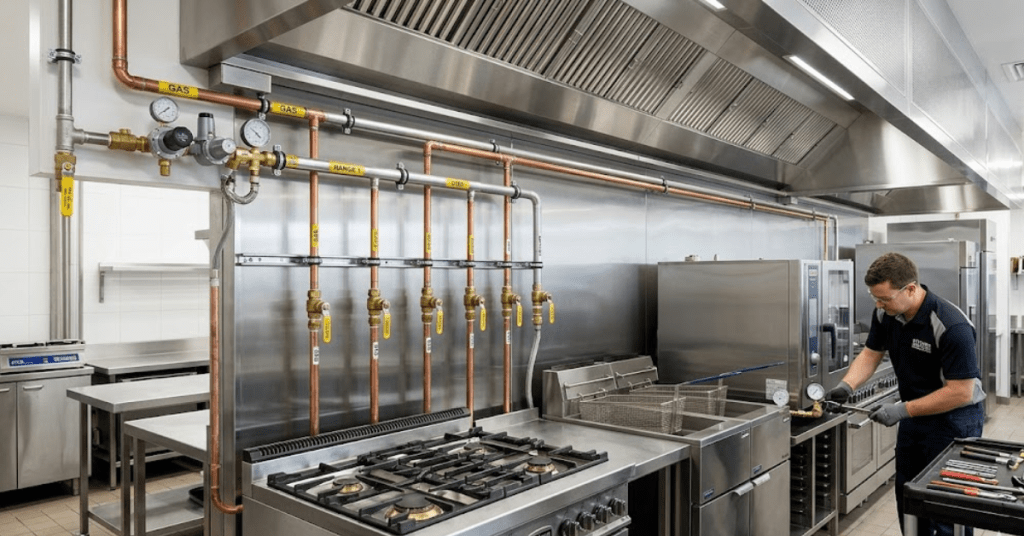
Opening a new restaurant, cafe or commercial kitchen in Perth? The excitement of designing your menu and fit-out can quickly stall when you run into the technical side of things, especially gas plumbing Perth requirements. Getting your gas installation right from the start is not just about ticking boxes. It is about keeping your staff safe, staying compliant with Western Australian regulations, and avoiding costly rework down the track.
Whether you are building a brand-new commercial kitchen or upgrading an existing one, the gas fit-out stage is one of the most critical steps in the process. From selecting the right appliances to ensuring proper ventilation and insulation, every detail matters.
This checklist walks you through the key stages of a commercial kitchen gas fit-out in Perth. We have drawn on real project experience and current Australian standards to give you a practical guide covering installations, compliance and safety from start to finish.
Why Your Commercial Kitchen Gas Fit-Out Needs Careful Planning
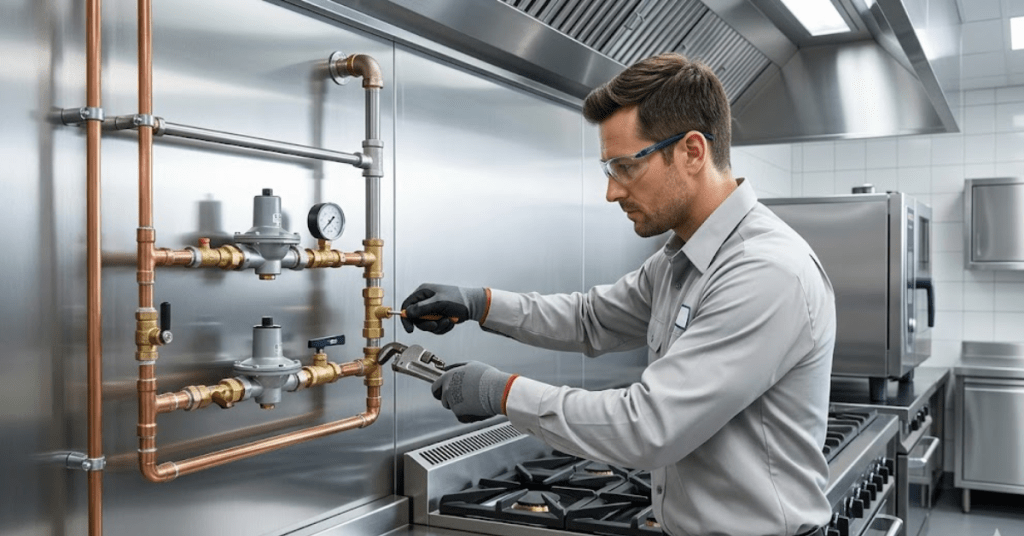
Commercial kitchen gas installations are a different beast compared to residential work. You are dealing with higher gas loads, multiple appliances running simultaneously, stricter ventilation requirements and more complex pipework. Get something wrong, and you could face failed inspections, expensive retrofitting, or a serious safety incident.
In Perth, commercial kitchen fit-outs must comply with AS/NZS 5601.1:2022 Gas Installations, the national standard governing gas system design, installation and commissioning. The 2022 edition introduced key changes around isolation valves in commercial kitchens and fire emergency isolation requirements for certain piping materials.
Perth business owners often underestimate the complexity of a commercial gas fit-out. Common issues include:
- Undersized gas supply lines that cannot support multiple high-demand appliances
- Incorrect clearances between gas appliances and combustible materials
- Inadequate ventilation causing poor air quality and potential carbon monoxide risks
- Missing isolation valves, which are now mandatory under the updated standard
- Hiring unlicensed or underqualified installers who are not across current regulations
Each of these issues can result in failed compliance inspections, project delays and significant additional costs. That is why working with a qualified gas fitter from the planning stage is so important.
Step 1: Design and Planning for Gas Plumbing Perth Kitchens
A solid gas fit-out starts well before anyone picks up a wrench. The design and planning phase sets the foundation for everything that follows.
Assess Your Appliance Requirements
Start by listing every gas appliance you plan to install. This typically includes commercial cooktops, ovens, deep fryers, chargrills, salamanders and combi ovens. Each appliance has a specific gas consumption rate (measured in megajoules per hour, or MJ/h), and your gas supply must be sized to handle the total load when all equipment runs at peak capacity.
Your gas fitter will need the manufacturer specifications for each appliance to calculate the total gas demand. This determines the size of the main supply line and internal pipework.
Work With Your Builder and Kitchen Designer Early
Gas plumbing needs to be coordinated with your kitchen designer, builder, electrician and mechanical ventilation contractor. The position of gas outlets, pipework runs and ventilation ducts all need to be mapped out before construction begins. Changing things later is always more expensive.
If you are working with a project manager or builder, make sure your licensed gas fitter is involved in early coordination meetings. At Alkimos Plumbing and Gas, we regularly collaborate with builders and designers during the planning phase to prevent clashes and keep projects on schedule.
Confirm Your Gas Supply Type
Most commercial kitchens in Perth are connected to natural gas, but some areas may still rely on LPG (liquefied petroleum gas). Your appliances need to be matched to the correct gas type, and any conversion must be carried out by a licensed professional. Check with your gas supplier early to confirm availability and connection timelines.
Step 2: Gas Installation Requirements and Compliance
Once your design is locked in, the physical gas installation begins. This is where compliance with Australian standards becomes non-negotiable.
Pipework and Sizing
All consumer piping must be installed in accordance with AS/NZS 5601.1:2022. This covers material selection, jointing methods, support and protection of pipes, and minimum clearances from other services. In commercial kitchens, copper, steel and multilayer pipe are the most common materials.
Under the 2022 standard, metallic consumer piping must extend at least one metre into the building from the gas metre outlet before transitioning to multilayer pipe. Multilayer pipe must also be kept at least one metre from the nearest part of any gas appliance to prevent heat damage.
Isolation Valves
One of the most significant changes in the 2022 standard is the requirement for a quarter-turn isolation valve or an emergency stop button with a solenoid and pressure-proving system where more than one commercial catering appliance is connected. Clear signage identifying the isolation point is also required.
Each individual gas appliance must also have its own isolation valve that is accessible for servicing. This is covered under Clauses 6.6.3 and 6.6.4 of the standard.
Appliance Regulators
An appliance regulator must be fitted to each gas appliance, installed as close to the appliance as practicable and accessible for servicing and adjustment. This ensures each unit receives the correct gas pressure for safe and efficient operation.
Hose Assemblies and Restraints
If your appliances are connected by flexible hose assemblies (common for equipment on wheels or castors), the hose must be one continuous length, installed in a U-shape, and free from kinks or permanent deformation. There must be at least 50 mm clearance between the bottom of the hose loop and the floor.
For appliances weighing more than 20 kg that are on castors or wheels, a restraint must be fitted to prevent the appliance from being pulled beyond the hose length when moved for cleaning. A bumper must also be installed to maintain the minimum clearance between the appliance and the wall behind it.
Step 3: Ventilation and Clearance Checks for Gas Fitting Services
Ventilation is one of the most overlooked areas in a commercial kitchen gas fit-out. Inadequate ventilation can lead to a build-up of combustion products, poor indoor air quality and even carbon monoxide poisoning.
Fresh Air Supply
The amount of ventilation required depends on the type and number of gas appliances installed. Clause 6.4 of AS/NZS 5601.1:2022 covers the adequacy and quality of air supply and the measures needed to ensure fresh air is available to gas appliances. In a busy Perth commercial kitchen running multiple burners and ovens, getting this wrong can have serious consequences.
Your mechanical ventilation system (range hood, exhaust canopy and make-up air) must be designed in conjunction with the gas installation.
Clearances From Combustible Materials
Every gas appliance must be installed with adequate clearance from combustible surfaces. Clearances must either meet the manufacturer’s installation instructions, ensure nearby surfaces do not exceed 65 degrees Celsius, or comply with the minimum clearance specifications outlined in the standard.
Using non-combustible bench materials is strongly recommended in commercial kitchens. Non-combustible surfaces allow for tighter spacing between appliances and benchtops, which is especially valuable in compact Perth kitchens where space is at a premium.
Fires have occurred in commercial kitchens where operators assumed a tiled or stainless steel wall was non-combustible, only for the heat to ignite timber framing behind the cladding. Always confirm the full wall composition, not just the outer surface.
Step 4: Testing, Commissioning and Certification
Before your commercial kitchen can receive a gas supply, the entire installation must be tested, commissioned and certified by a licensed gas fitter.
Pressure Testing
All gas installations must be pressure tested to confirm they are gas-tight before commissioning. In Western Australia, the WA Government’s Building and Energy division is clear: there is no allowable leakage rate. Every installation must be completely gas-tight. Leaving any gas leak in an installation is unsafe and a breach of regulations and can result in enforcement action.
Commissioning
Commissioning involves connecting the installation so it is available for use. Your gas fitter must verify that each appliance operates correctly, gas pressures are within specification, ventilation systems are functioning, and all safety devices are operational.
Notice of Completion
Once the work is complete, your gas fitter must submit a Notice of Completion (NOC) to the gas supplier and provide a copy to you. A compliance badge or label must also be fixed to the installation, identifying the scope of work. Gas suppliers generally will not connect your supply without this documentation.
At Alkimos Plumbing and Gas, we handle all testing, commissioning and documentation as part of our commercial plumbing services, so you know the compliance side is sorted.
Step 5: Ongoing Safety and Maintenance
Your gas fit-out does not end once the kitchen is up and running. Ongoing maintenance is essential for safety and continued compliance.
- Schedule regular inspections of all gas appliances, hose assemblies, regulators and isolation valves
- Check for signs of wear, corrosion or damage to flexible connections, especially on appliances that are frequently moved for cleaning
- Ensure ventilation systems and exhaust canopies are serviced regularly to maintain airflow
- Train kitchen staff on how to locate and operate the emergency isolation valve
- Keep records of all maintenance and inspection dates for compliance audits
If you notice a gas smell, unusual flame colours (yellow or orange instead of blue), or appliances that are not heating properly, contact a licensed gas fitter immediately. You can also read our guide on how to spot hidden gas safety dangers before it is too late for more practical tips.
When to DIY vs Call a Professional
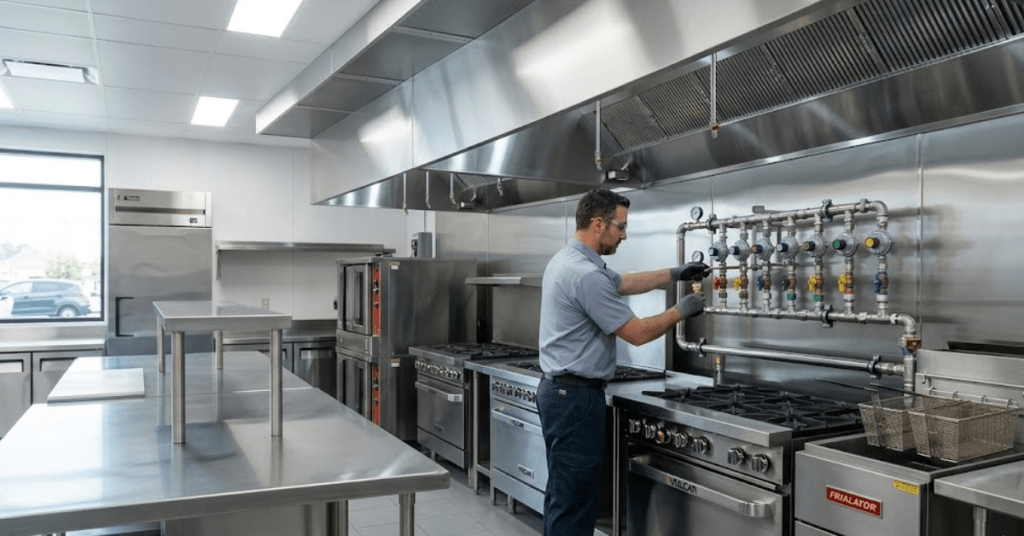
When it comes to gas work in a commercial kitchen, the answer is almost always to call a professional.
Under the Gas Standards Act 1972 (WA), all gasfitting work in Western Australia must be carried out by a person holding a gasfitting permit issued by Building and Energy. This includes installation, removal, replacement, alteration, maintenance and repair of gas installations. Doing gas work yourself, or hiring someone without the correct licence, is illegal and puts lives at risk.
What you can do yourself:
- Visually check appliance connections and hoses for obvious wear or damage
- Keep the area around gas appliances clean and free of grease buildup
- Ensure ventilation openings are not blocked
- Know where your emergency isolation valve is and how to operate it
What you must leave to a licensed gas fitter:
- Any installation, alteration or repair of gas pipework or appliances
- Pressure testing and commissioning
- Gas leak detection and repairs
- Appliance conversions (e.g. natural gas to LPG)
- Annual servicing and compliance checks
If you are unsure whether something requires a licensed professional, it almost certainly does. Our guide on how to find the right gas plumber is a good starting point.
Frequently Asked Questions
Do I need a separate gas isolation valve for each appliance in my commercial kitchen?
Yes. Under AS/NZS 5601.1:2022, each appliance must have its own accessible isolation valve. Where more than one commercial catering appliance is connected, a quarter-turn isolation valve or emergency stop button with pressure proving is also required for the overall kitchen installation.
How do I know if my gas fitter is properly licensed in WA?
You can verify a gas fitter’s licence through the Building and Energy licence and registration search on the WA Government website. In Western Australia, only persons holding a valid gasfitting permit issued by Building and Energy are legally authorised to carry out gas work.
What happens if my commercial kitchen gas installation fails an inspection?
A Notice of Defects or Inspector’s Order may be issued, requiring rectification within a specified timeframe. Depending on severity, gas supply may be disconnected until issues are resolved. Working with an experienced gas fitter from the outset is the best way to avoid this.
Can I convert my commercial kitchen appliances from natural gas to LPG (or vice versa)?
Conversions must be carried out by a licensed gas fitter using manufacturer-approved conversion kits. Incorrectly converted appliances are a serious safety risk and will not pass a compliance inspection. Always confirm the gas type your appliances are rated for before purchasing.
How often should I have my commercial kitchen gas installation inspected?
There is no single mandated inspection frequency for all commercial kitchens, but annual servicing by a licensed gas fitter is strongly recommended. Equipment with pressure-raising or overpressure protection devices must be serviced within two years of installation and every two years thereafter.
What are the penalties for unlicensed gas work in Western Australia?
Carrying out gas work without a valid permit breaches the Gas Standards Act 1972 and can result in significant fines. Unlicensed work also carries serious safety risks and may void your insurance coverage.
Does Alkimos Plumbing and Gas handle commercial kitchen gas fit-outs in Perth?
Yes. Alkimos Plumbing and Gas provides full-service commercial kitchen gas fit-outs across Perth, from planning and design through to installation, testing, commissioning and ongoing maintenance. We work closely with builders, designers and business owners to deliver compliant, safe installations.
Keep Your Commercial Kitchen Safe and Compliant Today
A well-planned commercial kitchen gas fit-out protects your staff, your customers and your business. From sizing your gas supply and installing compliant pipework to pressure testing and ongoing maintenance, every step of the process matters.
The key takeaways are simple: engage a licensed gas fitter early in the planning process, insist on compliance with AS/NZS 5601.1:2022, and never cut corners on safety. If you are unsure about any aspect of your gas plumbing Perth project, it is always better to ask a professional than to guess.
Alkimos Plumbing and Gas is here to help Perth businesses get their commercial kitchen gas installations right the first time. Whether you need a full fit-out, an upgrade, or a compliance check, get in touch with our team today to discuss your project.