
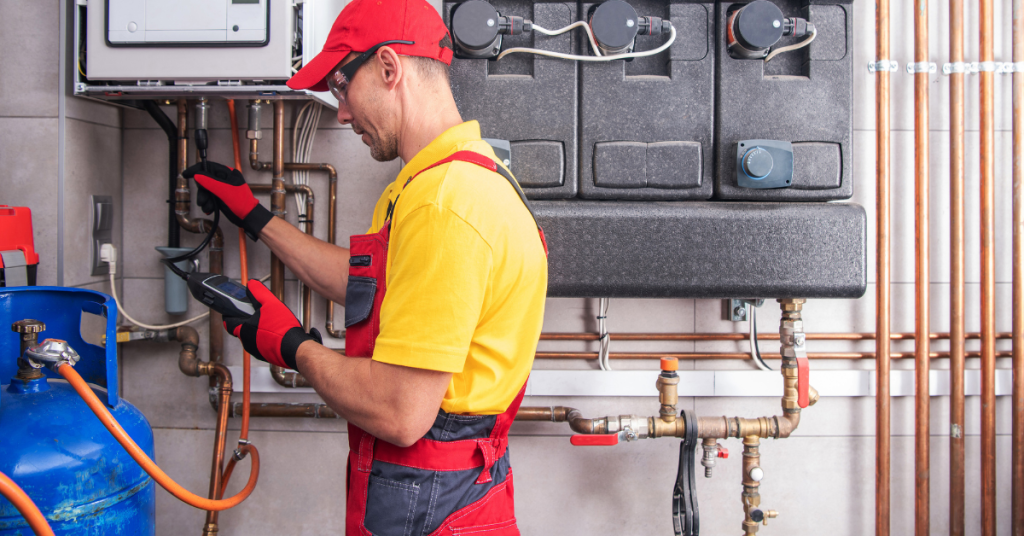
You walk into your cafe before opening and catch a faint whiff near the cooktop. By the time customers arrive it has faded, so you shrug it off. A week later your gas bill is higher than usual, and a staff member mentions a lingering headache. On their own these things seem minor. Together, they can be the early warning of a gas leak that has been quietly building for weeks.
This is where gas leak detection matters most. In busy Perth commercial premises, the obvious rotten-egg smell often gets masked by cooking odours, cleaning products and foot traffic, so leaks are easy to miss until they turn dangerous or expensive.
At Alkimos Plumbing and Gas, we help Perth homeowners and businesses spot the subtle signs early and understand what a licensed repair involves. This guide covers the quiet clues most people overlook, how professional detection works, what to expect when a gas fitter arrives, and where the law draws the line on doing it yourself.
Why Gas Leak Detection Matters in Perth Commercial Premises
Natural gas is odourless. Suppliers add a chemical called mercaptan to give it that familiar rotten-egg smell, which is your first line of defence. The trouble in commercial settings is that this warning smell competes with a lot of other, stronger smells.
Picture a commercial kitchen. Between fryers, cleaning chemicals, coolroom motors and constant movement, a small leak can go unnoticed for a long time, and the ventilation that keeps the space comfortable can disperse the smell before anyone connects the dots.
Perth adds its own challenges. Our hot, dry summers and salty coastal air are hard on metal fittings. Along Perth’s coastal suburbs, corrosion on external pipework and meter connections is a common culprit. Older inner-city premises may have ageing steel pipes, while newer estates can develop leaks at appliance connections that were not seated correctly during fit-out.
Gas leaks in commercial premises also carry higher stakes than in a home. More appliances, longer pipe runs and more people relying on the space mean a leak that would be a nuisance at home can become a real safety and business-continuity risk.
There is a financial cost too: a small, continuous leak wastes gas you pay for month after month, and many owners only investigate once the bills climb. In a commercial setting, you cannot always rely on your nose.
Subtle Signs of a Gas Leak Business Owners Overlook
Most people picture a strong smell. In reality, the early signs are often much quieter.
Keep an eye and ear out for:
- A faint or intermittent smell near appliances, meters or wall cavities, especially first thing in the morning before the space is aired out.
- A hissing or whistling sound near a gas line, fitting or appliance when things are quiet.
- Unexplained increases in your gas bill with no change in how much you are cooking or heating.
- Yellow or orange burner flames instead of a crisp blue flame, which can point to incomplete combustion.
- Sooty black marks or scorching around an appliance or its flue.
- Pilot lights that keep going out for no obvious reason.
- Dead or dying plants near an underground gas line outside, or patches of discoloured grass.
There is also a health dimension you should never ignore. Faulty or poorly maintained appliances can release carbon monoxide, an odourless, colourless gas. Warning signs in people include headaches, dizziness, nausea, blurred vision and unusual tiredness that eases when they leave the building.
If several staff feel unwell in the same area, treat it seriously. Carbon monoxide symptoms are easy to blame on a long shift or a winter cold, which is exactly what makes them so dangerous.
A single sign is not proof of a leak, but a combination of them, or any sign paired with people feeling unwell, is your cue to act. Our guide on how to spot hidden gas dangers before it is too late goes deeper on the warning signs worth watching.
How Professional Gas Leak Detection Works
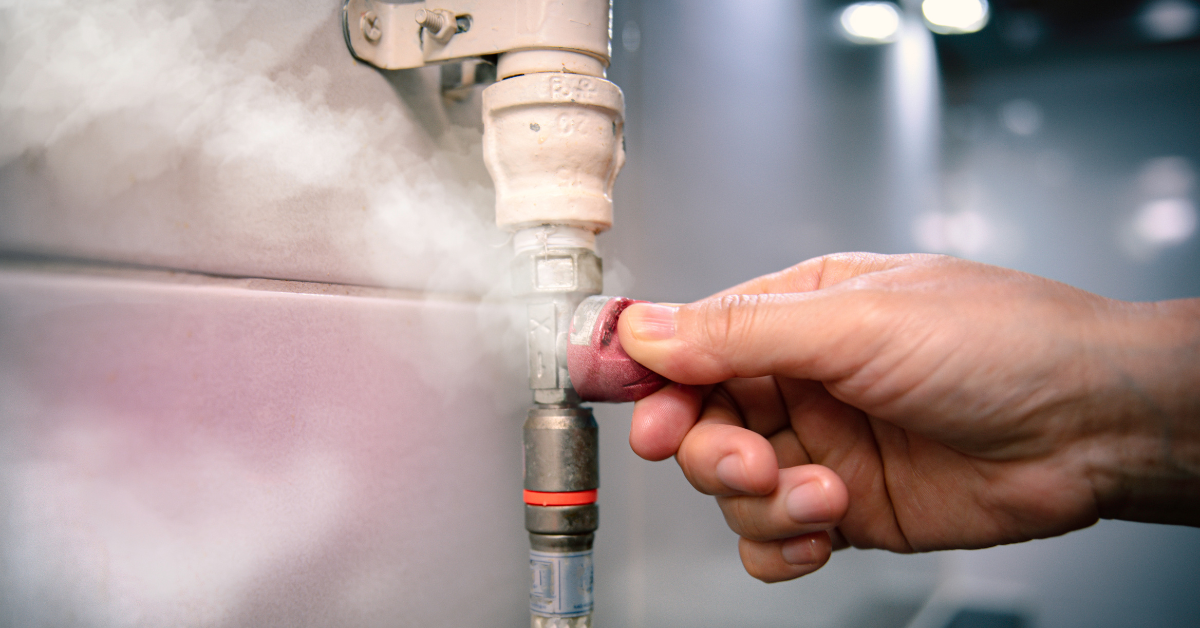
When you cannot pinpoint the source yourself, professional gas leak detection takes the guesswork out. Licensed gas fitters use several methods rather than relying on smell alone.
It usually starts with a visual inspection of accessible pipes, joints, fittings and appliance connections. From there, a technician reaches for specialised tools, including:
- Electronic gas detectors that sense tiny concentrations of gas in the air and help trace a leak back to its source.
- Leak-detection solution applied to fittings, which bubbles up wherever gas is escaping.
- Pressure testing with a manometer, where the system is pressurised and monitored to see whether it holds or loses gas.
“In 23 years in this industry, I have learned that the difference between a guess and a proper diagnosis is everything. Our job is to give you a clear answer, not a maybe, because when it comes to gas, there is no room for cutting corners.”
— Martin Lockheart, Director, Alkimos Plumbing and Gas
Pressure testing matters a great deal in Western Australia because there is no allowable leakage rate here. Under state regulations enforced by Building and Energy, gas installations are held to a very strict standard; even a small drop in pressure is treated as a fault that needs fixing.
For commercial premises with long pipe runs and multiple appliances, detection can be more involved. A technician may isolate sections one at a time to narrow down the problem, rather than opening walls or digging up ground unnecessarily.
This methodical approach is the biggest advantage of calling a professional: instead of guessing, you get a clear answer about whether there is a leak, where it is, and what is causing it. If you would like this handled by qualified locals, the Alkimos Plumbing and Gas gas leak detection Perth service covers exactly this.
What Happens During a Licensed Gas Leak Repair
If a leak is confirmed, here is what a professional gas leak repair typically involves. The exact steps vary with the situation, but the framework stays the same.
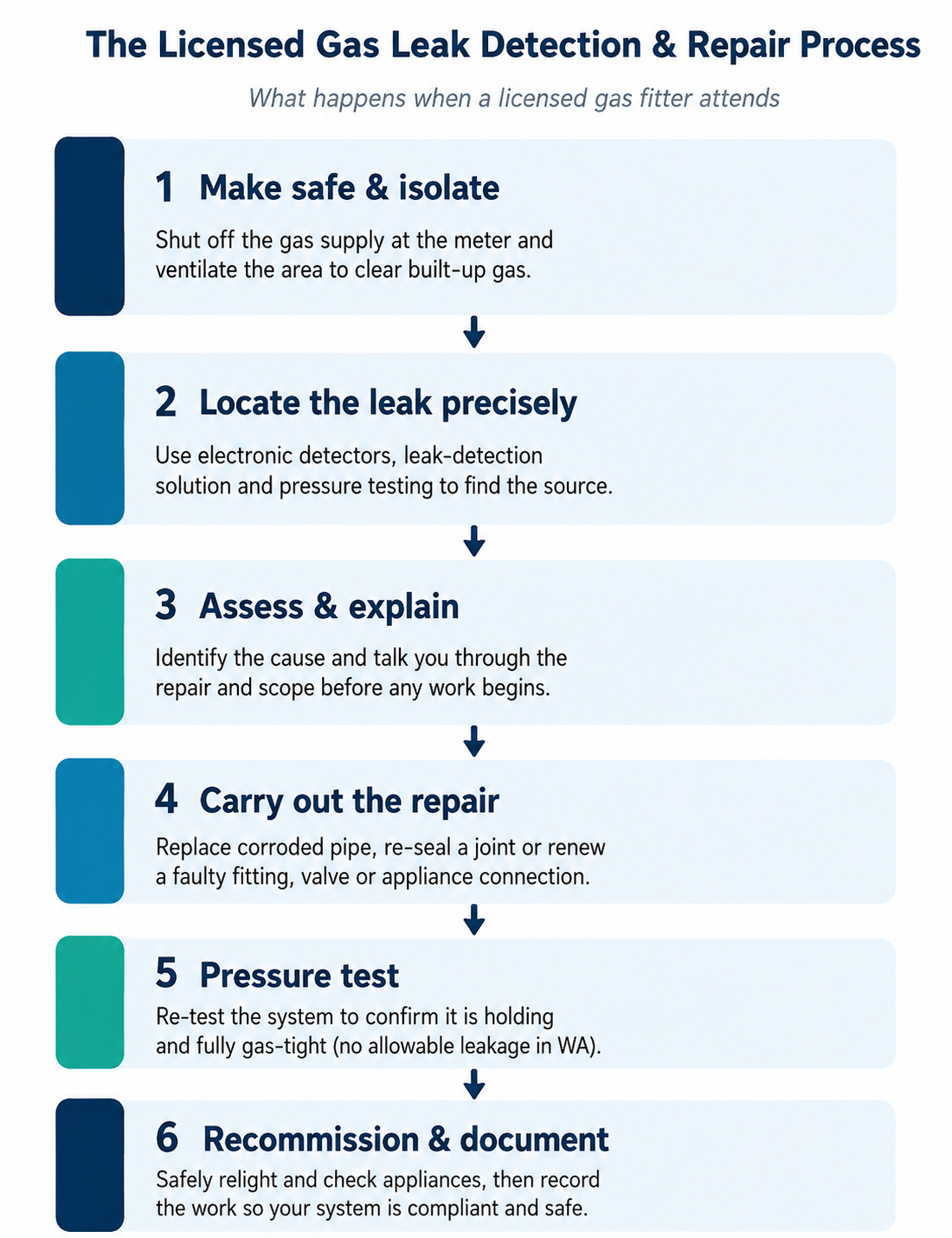
- Make safe and isolate: The gas fitter shuts off the supply, usually at the meter, and ventilates the area to clear any built-up gas.
- Locate the leak precisely: Using the detection methods above, the technician confirms the exact source rather than treating symptoms.
- Assess and explain: You are told what is causing the leak and what the repair involves, with a clear idea of scope before work starts.
- Carry out the repair: This might mean replacing a corroded pipe section, re-sealing a joint, or renewing a faulty connection or valve.
- Pressure test the system: Once repaired, the installation is pressure tested again to confirm it is holding and fully gas-tight.
- Recommission and document: Appliances are safely relit and checked, and the work is recorded so you have a compliant, safe system.
All of this must be carried out by a licensed gas fitter. In Western Australia, gasfitting work can only legally be done by someone licensed by Building and Energy, the state regulator. That is not red tape for its own sake: gas installations that look and run fine can still be unsafe, which is why the law restricts this work to qualified people.
Repairs also need to meet the national standard AS/NZS 5601.1, which sets out how gas systems must be designed, installed and commissioned across residential, commercial and industrial properties. For bigger jobs, our Perth gasfitting and repair team handles everything from a single faulty fitting to full system work.
Simple Ways to Reduce Gas Leak Risk and Cost
You cannot control everything, but a few habits go a long way, especially for busy Perth businesses.
Alkimos Plumbing and Gas recommends the following:
- Book regular gas safety checks so small issues are caught before they become leaks or breakdowns.
- Keep appliances serviced to the manufacturer’s schedule, particularly high-use commercial equipment.
- Watch your gas bills and investigate unexplained jumps early.
- Keep ventilation clear around appliances and flues so fumes and any escaping gas can disperse.
Get fit-outs done right the first time. Poorly seated connections during a rushed fit-out are a common source of leaks, as our commercial kitchen fit-out guide explains.
Preventive care is almost always cheaper than an emergency call-out and lost trading hours. Still, if something goes wrong after hours, our 24-hour emergency plumbing team is there when you need an emergency plumber in Perth fast.
When to Handle It Yourself and When to Call a Professional
Gas is one area where the DIY line is drawn very tightly, and for good reason.
What you can safely do yourself:
If you smell gas, stop and avoid anything that could create a spark. Do not use light switches, electrical appliances or mobile phones inside.
- Open doors and windows to ventilate the area.
- Turn off the gas at the meter if you can reach it safely.
- Leave the building and move everyone to fresh air.
- Once you are safely outside, report a suspected leak to the network operator. In Perth that is ATCO on 13 13 52, available 24/7. If anyone is unwell or you fear immediate danger, call 000.
What you should never attempt:
- Tightening, sealing or repairing gas pipes, fittings or appliances yourself.
- Trying to locate an internal leak with makeshift tools.
- Reconnecting or relighting an appliance after a suspected leak.
In Western Australia it is illegal for anyone without a gas fitter’s licence to carry out gasfitting work, and the reason is simple: getting it wrong risks fire, explosion and carbon monoxide exposure. When in doubt, make the area safe and call a licensed professional.
Frequently Asked Questions
How can I tell if I have a gas leak if I cannot smell anything?
Smell is only one clue. Watch for hissing sounds, higher gas bills, yellow burner flames, pilot lights that keep going out, and dead vegetation near outdoor gas lines. If people feel unwell indoors, take it seriously, because carbon monoxide is odourless.
Who do I call first if I smell gas in Perth?
Get everyone out, and once you are safely outside, call ATCO on 13 13 52 to report it to the network operator. Call 000 if there is immediate danger. To locate and repair a leak on your side of the meter, you will need a licensed gas fitter.
Is a small gas leak really that dangerous?
Yes. Western Australia holds gas installations to a strict standard, so even a small leak is treated as a fault that must be fixed. Even a small one wastes gas and can build up in enclosed spaces over time.
How long does gas leak detection and repair take?
A straightforward leak at an accessible fitting can often be found and repaired in a single visit. Commercial systems with long pipe runs or multiple appliances can take longer, since each section may need to be isolated and tested.
How often should commercial premises have a gas safety check?
At least once a year suits most businesses, and more often for high-use commercial kitchens. Regular checks catch small faults before they become leaks or breakdowns.
Do I legally need a licensed gas fitter for repairs?
Yes. In WA, gasfitting work must be carried out by a licensed professional. It is not just about compliance; it is about keeping your people and property safe.
Book a Gas Safety Check in Perth
Gas leaks rarely announce themselves loudly, especially in busy commercial premises where the tell-tale smell gets lost in the day-to-day. The quieter signs, a faint odour, a creeping gas bill, a flickering pilot light or staff who feel off, are all worth taking seriously. Early gas leak detection protects your people, your property and your bottom line.
If something feels off, you do not have to work it out alone. Alkimos Plumbing and Gas provides professional gas leak detection, repair and gas plumbing across Perth for homes and businesses alike.
Our licensed team will find the problem, explain it plainly and put it right. Reach out to our Perth gas plumbing team for a safety check or repair, and get the peace of mind that your gas system is sound.